


InnovateR: Rewriting Regulation for the Digital Economy Era


"Where regulation becomes an enabler — not an obstacle — of innovation, investment, and inclusive growth."
🌪 InnovateR: Transforming Regulation from Roadblock to Launchpad
"There Is No Crisis — Only Change. And If You're Not Riding It, You're Resisting It."
Welcome to the Future of Digital Regulation
At Artifex Consulting LLC, we don't believe in simply updating regulations. We believe in rewriting them — so they don't become roadblocks to innovation, but launchpads for it. While most regulatory frameworks still treat digital services like upgraded phone lines, the world has moved on. Today's economy runs on AI, IoT, cloud-native platforms, and decentralized connectivity. But regulation? Too often, it lags by a decade.
That ends now.
Introducing InnovateR — a first-of-its-kind consulting framework that transforms how regulators, governments, and institutions approach digital policy, shifting focus from traditional Information, Technology & Communications (ICT) to Digital Services, Ecosystems, and Value Creation.
This isn't reform. It's regulatory reinvention.

📊 The Context: Why Transformation Is Urgent
Traditional telecom law structures were built around rigid categories — definitions, scope, licensing, spectrum, and sanctions. While these were essential for building foundational connectivity in the 20th century, they're ill-equipped to regulate modern digital services that cross sectors, blur boundaries, and require agile, adaptive regulation.
The shift is clear: We must expand regulatory scope beyond traditional telecom frameworks to embrace a holistic digital economy approach centered on four strategic pillars:
✅ Digital Services
✅ Digital Economy
✅ Innovative Approach
✅ Empowered Users

🌍 The Informal Economy Imperative
The numbers tell a compelling story. As of 2025, approximately 2 billion people work in the informal economy — representing roughly 57.8% to 60% of the global workforce. More than 8 in 10 enterprises worldwide are considered informal.
Regional realities:
- Africa: 85% of workers in informal sector
- Asia-Pacific: 1.3 billion informal workers (66% of regional employment)
- Latin America & Caribbean: 46.7-47% informal employment rate
- Youth unemployment: 12.6%, with many pushed into informal roles
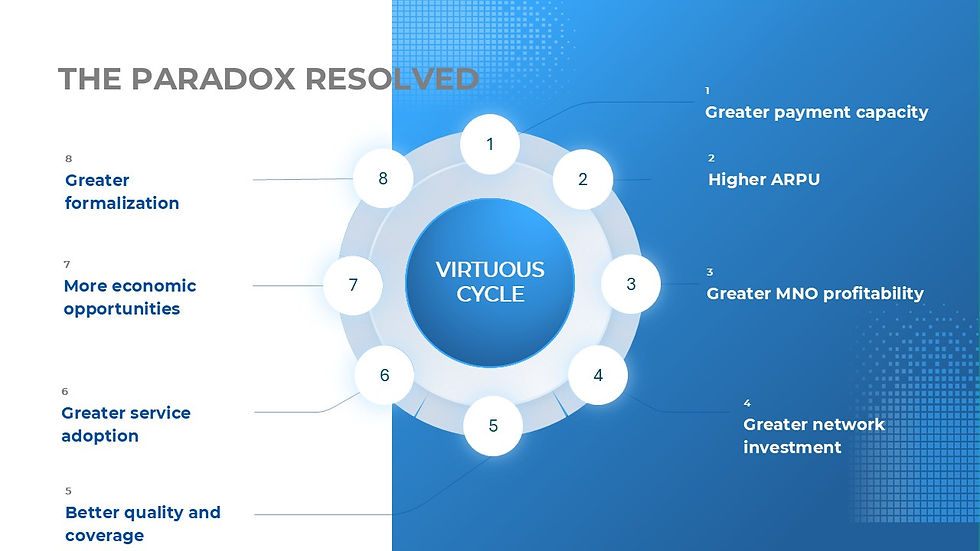
The informal sector contributes approximately 35% of GDP in low- and middle-income countries. Yet these workers lack social protection, face precarious conditions, and earn significantly less. This is where digital transformation becomes economic transformation. By migrating from traditional economies based on tourist services and mining to economies powered by digital services, nations can formalize employment, expand opportunities, and create inclusive growth.

💡 The Digital Economy Framework: Four Pillars of Transformation
Our approach places the digital economy at the center of public policy through four interconnected pillars:
1️⃣ Digital Economy
Placing the digital economy centered on the exchange of fully digital goods and services at the heart of public policy. This creates an enabling environment for innovation, competition, and investment while supporting digital entrepreneurship and cross-border trade.
2️⃣ Digital Skills
Executing comprehensive training measures for populations to develop essential digital competencies. A digitally skilled workforce is the foundation of a competitive digital economy.
3️⃣ Impact Measure
Designing strategies to measure social impact in the digital economy and monitor compliance with goals and objectives. What gets measured gets managed — and improved.
4️⃣ Technological Base
Promoting 5G as the technological backbone that will enable digital economy development across both formal and informal sectors, paving the way for 6G, edge computing, and rural digitalization.

🔄 Innovative Regulatory Approaches: From Restrictive to Vigilant
The effects of COVID-19 on the global economy have accelerated the urgent need for regulatory evolution. At Artifex, we focus regulatory policy on a fundamental change of approach — moving from traditional ex-ante models toward dynamic ex-post approaches.
We've identified three distinct regulatory mindsets:
🔴 Restrictive Approach
Prohibiting or restricting products and processes based on perceived risks or uncertainties. While cautious, this model often stifles innovation before it can demonstrate value.
🟢 Proactive Approach
Actively facilitating and regulating new products and processes while considering their potential social and economic benefits. This is regulation as an enabler, not a barrier.
🟣 Vigilant Approach
Acting only when risks have materialized or when activity has reached sufficient volume to impact a significant number of consumers. This balanced approach allows innovation to flourish while protecting public interest.
The future belongs to regulators who embrace proactive and vigilant approaches — creating space for innovation while maintaining oversight.
🎯 Focus Settings: Adaptive Regulation Across Three Dimensions
One size does not fit all. InnovateR recognizes that different services, technologies, and levels of integration require different regulatory responses.
Our Focus Settings Framework allows NRAs to calibrate their regulatory approach across three critical dimensions:
📡 Services — From basic connectivity to complex digital platforms
🔧 Technologies — From established infrastructure to emerging innovations
🔗 Integration — From standalone services to fully interconnected ecosystems

For each regulatory tool — whether Wait and See, Test and Learn, Innovation Hubs, Sandbox, or RegTech — regulators can adjust their intensity and focus based on:
- The maturity of the service
- The novelty of the technology
- The degree of market integration required
This wide flexibility ensures that NRAs can respond precisely to market realities — applying lighter touch regulation where innovation is nascent, and more structured oversight where services are mature and widely adopted.
🛠️ The InnovateR Design Process: A Systematic Approach to Regulatory Innovation
InnovateR isn't just a philosophy — it's a structured, repeatable methodology that guides NRAs through evidence-based regulatory design.
Our design process follows a clear, iterative pathway:
📊 Phase 1: Condition Assessment
Understanding the current market landscape, technological readiness, and stakeholder capabilities before setting direction.
🎯 Phase 2: Targets
Defining clear, measurable objectives aligned with national digital economy goals and consumer protection mandates.
🔍 Phase 3: Focus
Selecting the appropriate regulatory approach (Wait and See, Test and Learn, Innovation Hubs, Sandbox, or RegTech) based on market requirements and service maturity.
🧪 Phase 4: Simulation
Testing regulatory frameworks in controlled environments before full deployment — minimizing risk while maximizing learning.
📈 Phase 5: Performance
Monitoring implementation effectiveness against defined targets and KPIs.
💥 Phase 6: Impact
Measuring real-world outcomes on innovation, competition, consumer welfare, and economic growth.
🔄 Re-Design Loop
Based on impact assessment, the framework feeds back into the innovation policy foundation, enabling continuous improvement and adaptation.
This cyclical, evidence-based approach ensures that regulation evolves alongside technology — never static, always improving, consistently aligned with market realities.

🌐 Innovation Tools in Practice
🔍 Wait and See
Regulators observe and monitor innovation trends under arm's-length conditions, intervening only where and when necessary. This builds intelligence and reduces regulatory overreach while enabling early detection of risks and opportunities.
🧪 Test and Learn
Regulators create custom frameworks for specific business cases, allowing companies to test new services in live, controlled environments — often with exemptions such as "no objection" or "no action" letters. This reduces uncertainty for innovators while ensuring appropriate oversight.
🌐 Innovation Hubs
Dedicated collaborative spaces where regulators, startups, academia, and industry work together on solutions. These hubs foster dialogue, co-design of rules, and shared learning — transforming regulation from a barrier into a partnership.
🏖️ Regulatory Sandboxes
Safe spaces for firms to test products under relaxed rules with close monitoring. Sandboxes enable real-time adaptation, scalability, and efficiency while protecting consumers.
🤖 RegTech
Leveraging technology — AI, data analytics, automation — to enhance compliance monitoring, risk assessment, and decision-making. RegTech enables regulators to move at the speed of innovation.
⚖️ Law and Regulatory Reforms
Introducing new laws or improvements to existing frameworks in response to innovations, companies, or business models. This ensures the legal infrastructure evolves alongside technological advancement.

👤 The Empowered User: DUEHP Framework
At the heart of InnovateR is a simple but powerful principle: Users must be empowered, not just protected.
Our DUEHP Framework ensures that consumers transition from passive recipients to active participants in the digital economy:
D — Decisions ✊
Strengthening users' skills to select their operator, services, plans, payment methods, and service channels. Informed choice drives competition and quality.
U — Use 💻
Promoting digital services use as an alternative to earn income, embedding the digital economy into daily life, and developing practical digital skills that create economic opportunity.
E — Expression 📢
Strengthening capacity for expression in digital media — ensuring users can communicate, create content, and participate in digital public discourse safely and effectively.
H — Skills 🎓
Development of public policy that enables digital skills development, especially those that strengthen education and income generation. Digital literacy is economic literacy.
P — Privacy 🔒
Defining privacy elements on digital services, guaranteeing privacy protection, and ensuring information collected by digital platforms is safeguarded with transparency and user control.
Empowered users have greater power to select their digital service provider, design their service plans, and manage their accounts through digital channels — creating market pressure for better quality, lower prices, and more innovation.
🎯 Why InnovateR Matters for You
For Telecom Regulators & NRAs:
- Build internal expertise in digital technologies
- Improve responsiveness to market changes
- Strengthen stakeholder trust through transparency
- Create a culture of innovation within your organization
- Evolve from passive observers to active architects of the digital economy
- Access a structured, repeatable methodology for regulatory design
For Mobile & Fixed Operators:
- Faster time-to-market for new services
- Lower policy risk and regulatory uncertainty
- Clear pathways for innovation and investment
- Level playing field across platforms and business models
- Predictable regulatory frameworks that adapt to technological change
For Satellite Internet Operators:
- Regulatory frameworks that recognize cross-border, borderless services
- Harmonized approaches that enable global connectivity
- Support for rural and remote digitalization initiatives
- Flexible regulation calibrated to service maturity and integration levels
For Digital Companies:
- Agile, outcome-based regulations that evolve with technology
- Reduced barriers to entry and expansion
- Regulatory sandboxes for testing innovative solutions
- Clear rules that enable rather than constrain
- Focus settings that match regulatory intensity to your service's characteristics
For Investors:
- Lower policy risk and greater predictability
- Scalable digital infrastructure opportunities
- Faster ROI through streamlined approval processes
- Access to emerging markets with modernized regulatory frameworks
- Evidence-based regulation that supports sustainable growth
For International Development Partners:
- Build resilient, inclusive digital economies — not just networks, but ecosystems
- Formalize informal employment through digital opportunities
- Advance UN Sustainable Development Goals through digital inclusion
- Create measurable social impact alongside economic growth
- Empower users through the DUEHP framework
🌟 Our Mission: From Control to Enablement
At Artifex Consulting LLC, we guide policymakers to stop asking "How do we control this?" and start asking "How do we enable this?"
With InnovateR, we help you:
✨ Break down silos between telecom, data, competition, and consumer protection rules
✨ Design agile, outcome-based regulations that evolve with technology
✨ Unlock investment in 5G, 6G, edge computing, and rural digitalization
✨ Foster competition not just among operators — but across platforms, services, and business models
✨ Put people at the center — ensuring inclusion, affordability, and trust through the DUEHP framework
✨ Apply the right regulatory tool at the right intensity for the right market conditions
✨ Follow a systematic design process that ensures continuous improvement
🚀 The Bottom Line
We don't wait for disruption. We engineer it — responsibly, inclusively, sustainably.
Because the greatest risk today isn't technological change. It's regulatory stagnation.
As someone wrote: "There is no crisis — only those who refuse to change."
At Artifex, we don't fear change. We generate it.
💬 Ready to Transform Your Regulatory Framework?
Whether you're a regulator seeking to modernize your approach, an operator looking to innovate with confidence, a digital company needing clear pathways to market, or an investor seeking opportunities in emerging digital economies — InnovateR is your partner in transformation.
With our Focus Settings Framework, Design Process Methodology, and DUEHP User Empowerment Model, you have everything you need to build a digital economy that works for everyone.
Let's build the digital economy of tomorrow — today.


Comments