


THE MNO GROWTH PARADOX IN MEXICO

By Gerardo Mantilla | CEO & Founder, Artifex Consulting LLC
There is a polite fiction circulating in Latin American telecommunications circles. It holds that Mexico's connectivity challenges are, at their core, engineering problems—questions of spectrum allocation, tower density, and fiber backhaul. Build more infrastructure, the logic goes, and adoption will follow.
The last twelve months have demolished that fiction beyond repair.
In October 2026, Grupo Televisa and Fintech Holdings acquired AT&T México for USD $2 billion. Consider what that number actually represents: AT&T entered Mexico in 2014 with USD $4.4 billion in acquisitions, then poured more than USD $10 billion into infrastructure over a decade of aggressive deployment across 1.9 million square kilometers of challenging terrain. The company built a national network, acquired spectrum at globally anomalous prices, employed thousands, and competed relentlessly against the dominant incumbent.
Then it left, recovering 45 cents on the dollar.
Telefónica arrived at a similar destination through a different route. After a 2015 valuation of EUR €5.2 billion, the company returned its spectrum to the State and migrated to an MVNO model—an unprecedented concession from a Tier-1 global operator that amounted to a public acknowledgment of structural defeat.
These are not failures of management. They are not cyclical downturns. They are the market delivering a verdict on a business model that the Mexican economy, in its current configuration, simply cannot sustain.
The Anatomy of a Paradox
Our latest strategic analysis, The MNO Growth Paradox in Mexico: Economic Informality and the Imperative for Digital Formalization, documents what we believe is the most consequential structural contradiction in emerging-market telecommunications today.
Mexico has 156.5 million active mobile lines. Penetration exceeds 95%. By every conventional metric, this is a mature, connected market.
Yet effective internet usage tells a different story. Only 9.1% of mobile lines—13 million users—operate on 5G networks. The Average Revenue Per User across the market sits at MXN $142.8 per month, roughly USD $7.80. Movistar's ARPU has collapsed to MXN $74. Forty-seven million Mexicans still lack any form of internet access, and those who do connect routinely restrict their usage to WhatsApp and social media, tethering their digital lives to whatever public WiFi they can find.
This is not a coverage problem. It is a purchasing power problem wearing the mask of a technology problem.
The Mathematics That No One Wants to Read
The informal economy now generates 25.4% of Mexico's GDP—a record high—and employs 55% of the working population, approximately 34 million people. Average labor income stands at MXN $7,363 per month (USD $390), while 86% of household expenditure is consumed by essentials: food, housing, transport, healthcare.
Do the arithmetic. A postpaid commitment of any meaningful size is a luxury that more than half the workforce cannot rationally undertake. Hence the 84.36% prepaid dominance. Hence the extreme churn. Hence the revenue volatility that makes capital planning nearly impossible for any operator without Telcel's structural advantages.
Now layer in Mexico's globally anomalous spectrum pricing regime. Annual spectrum rights consume 80% of total operational costs for Mexican MNOs—compared to 12% in comparable international markets. Mexico is the only country in Latin America where assigned mobile spectrum is actually decreasing despite exponential growth in data demand. 346.5 MHz of spectrum sits unassigned because no operator can absorb the recurring fiscal burden.
When we model the economics of a competitive MNO in Mexico—25 million subscribers required for scale, MXN $142.8 ARPU, the prevailing cost structure—the result is an annual loss of approximately MXN $857 million. The time horizon for recovering a USD $10 billion infrastructure investment, under current conditions, is effectively infinite.
This is why the market can sustainably support one infrastructure-based operator with meaningful profitability (Telcel), one at marginal viability (the incoming Televisa/Fintech entity), and zero additional competitors. The aggregate revenue pool is simply too shallow.
The 5G Delusion
The industry's reflexive answer to every structural problem is the next generation of technology. 5G will unlock new use cases, stimulate demand, and justify the investment cycle.
We should be precise about what 5G deployment in Mexico actually requires. Analysys Mason estimates USD $37 billion in capital expenditure between 2028 and 2029 for full national deployment. That figure assumes 100,000 additional kilometers of fiber optic backhaul—Mexico currently has 3% of the fiber deployed in the United States—and nine to eleven times the current 53,562 tower installations.
Recovering that investment at current ARPU levels would require either a 400-500% increase in what Mexican users pay (economically impossible), a quadrupling of the subscriber base (demographically impossible given 156.5 million lines already in circulation), or some combination that exists only in slide decks.
5G in Mexico will remain what it already is: a premium service concentrated in high-income urban corridors, accessible to a minority, subsidised by the broader prepaid base, and never the engine of inclusive digital transformation that its proponents claim.
The Deeper Structural Truth
Governments, multilaterals, and regulators have spent the past decade deploying technology-first solutions: public WiFi, community networks, satellite coverage, universal service obligations. These interventions are necessary. They are also structurally insufficient.
Infrastructure without purchasing power creates white elephants. Coverage without adoption is a statistical illusion. Mexico's 95% mobile penetration coexists with one of the most severe effective digital divides in Latin America because the foundational constraint—household economic capacity—has never been addressed.
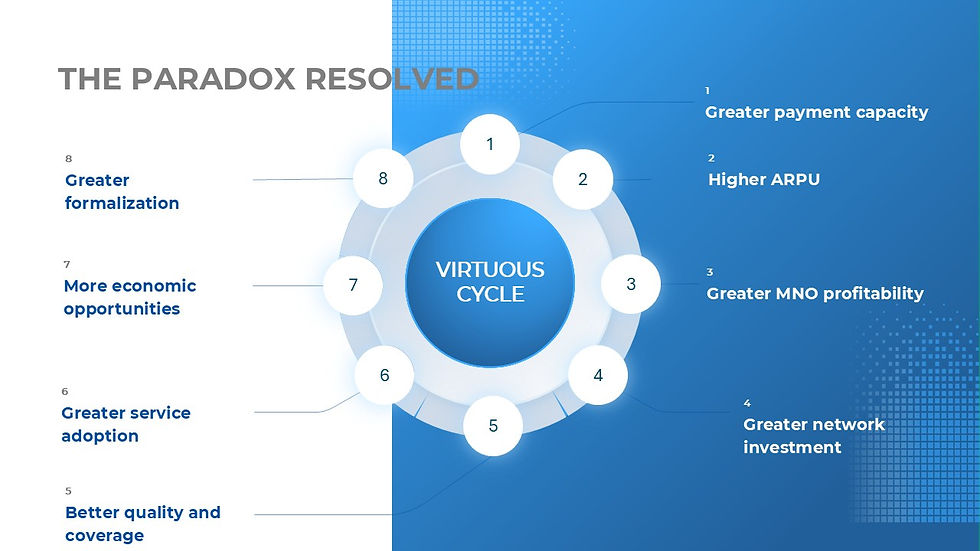
The vicious cycle is self-reinforcing: low incomes depress ARPU; depressed ARPU compresses profitability; compressed profitability curtails investment; curtailed investment degrades quality and coverage; degraded quality suppresses adoption; suppressed adoption entrenches low ARPU. Breaking this cycle requires interventions on the demand side—formalization, productivity growth, income expansion—that sit well outside the traditional telecommunications policy toolkit.
This is ultimately a development paradox, not a sectoral one. A nation cannot build a digital economy on the foundation of an informal economy. Until the purchasing power of Mexico's 62.1 million economically active citizens is structurally enhanced, the telecommunications sector will remain trapped in a cycle of underinvestment, constrained competition, and performative inclusion.
A Mirror, Not a Radio Wave
The spectrum is not merely radio waves. It is a balance sheet. It is investor confidence. It is digital sovereignty. And in Mexico today, it is a mirror reflecting the nation's deepest economic contradictions.
The departures of AT&T and Telefónica are not corporate events to be filed under "industry news." They are structural warnings. The question facing Mexico is no longer whether it can attract foreign telecommunications investment under current conditions—the empirical answer is demonstrably no—but whether the structural conditions themselves can be transformed to create a market where connectivity is economically viable for operators and genuinely affordable for the population.
Our full report, available now, provides the complete analytical framework, the underlying data from INEGI, IFT, GSMA, and the policy and strategic implications for operators, investors, and regulators navigating this terrain.
The polite fictions have expired. The arithmetic does not lie. What Mexico needs now is the intellectual honesty to confront it.


Comments