


Beyond 4G Obligations: Why Rural 5G Deployment Is an Economic Imperative, Not Just a Technological Choice


Some countries have conducted 5G spectrum auctions while concurrently imposing coverage obligations anchored in 4G technology—even permitting the use of alternative frequency bands, distinct from those auctioned, to satisfy these requirements. For example, Peru in 2025 executed an auction to assign the 3.5 GHz frequency band with coverage obligation to deploy 4G networks in rural zones using other frequency previously assigned to MNO.
While the underlying policy intent is commendable—namely, to reduce deployment costs in rural areas where 4G infrastructure may be absent, and to lower the entry barrier for end-users by favoring more affordable 4G-enabled devices—this approach risks overlooking critical technical and economic dimensions essential for achieving sustainable, high-value rural connectivity.
Strategic Spectrum Valuation and Technology Lifecycle Dynamics
Spectrum value is not static; it evolves dynamically based on technological capability, market adoption velocity, and the willingness of stakeholders to invest in its utilization. Spectrum that enables deployment of a technology preferred by the market—due to superior performance, operational efficiency, or service differentiation—commands a premium in both economic and strategic terms.
In this context, 5G delivers measurable advantages over 4G, even in rural deployment scenarios. When leveraged in the 700 MHz band, 5G combines exceptional propagation characteristics with advanced air interface efficiencies (e.g., flexible numerology, massive MIMO readiness, and beamforming), enabling both wider coverage and higher spectral efficiency per hertz. Crucially, even if the 700 MHz band were allocated for 4G within the same geographic footprint, the marginal CAPEX savings would not offset the long-term strategic and economic value of 5G. This is because 5G spectrum value is projected to appreciate over time—driven by ecosystem maturity, innovation cycles, and rising demand for low-latency, high-reliability services—whereas 4G value is expected to depreciate as the technology enters its maturity phase and market focus shifts decisively toward next-generation capabilities.
Economic Rationality: Investment Efficiency and Total Cost of Ownership
From an investment perspective, deploying 5G from the outset in rural areas aligns with principles of economic rationality and asset optimization:
- Future-Proofing Infrastructure: 5G-ready radio access networks (RAN) and core architectures support software-defined upgrades, reducing the need for costly hardware replacements as demand evolves. This extends asset lifespan and improves return on invested capital (ROIC).
- Operational Efficiency: 5G introduces significant energy-saving features (e.g., sleep modes, AI-driven traffic optimization) and network automation capabilities, lowering OPEX over the infrastructure lifecycle—particularly valuable in remote areas with limited power infrastructure.
- Scalable Architecture: 5G's cloud-native, service-based architecture enables MNOs to scale capacity incrementally. Operators can begin with coverage-focused deployments in low-band spectrum and seamlessly integrate mid-band (e.g., 3.5 GHz) or high-band resources as demand grows, avoiding over-provisioning and aligning investment with revenue generation.
- Risk Mitigation: Committing to 4G in newly served areas risks technological lock-in and stranded assets. By contrast, 5G deployment preserves strategic optionality, allowing operators to pivot toward emerging use cases without major reinvestment.
Revenue Diversification and Value Creation for MNOs
Beyond cost considerations, 5G unlocks new revenue streams that 4G cannot efficiently support—transforming rural connectivity from a cost center into a value-generating opportunity:
- Enterprise and Vertical Solutions: 5G enables private network offerings, network slicing, and ultra-reliable low-latency communication (URLLC), allowing MNOs to serve agriculture, mining, logistics, and public safety sectors with tailored, premium-grade connectivity.
- IoT and Massive Machine-Type Communications (mMTC): Rural economies stand to benefit from scalable IoT deployments (e.g., smart agriculture, environmental monitoring, asset tracking). 5G's native support for massive device density and low-power operation creates monetization pathways unavailable on 4G.
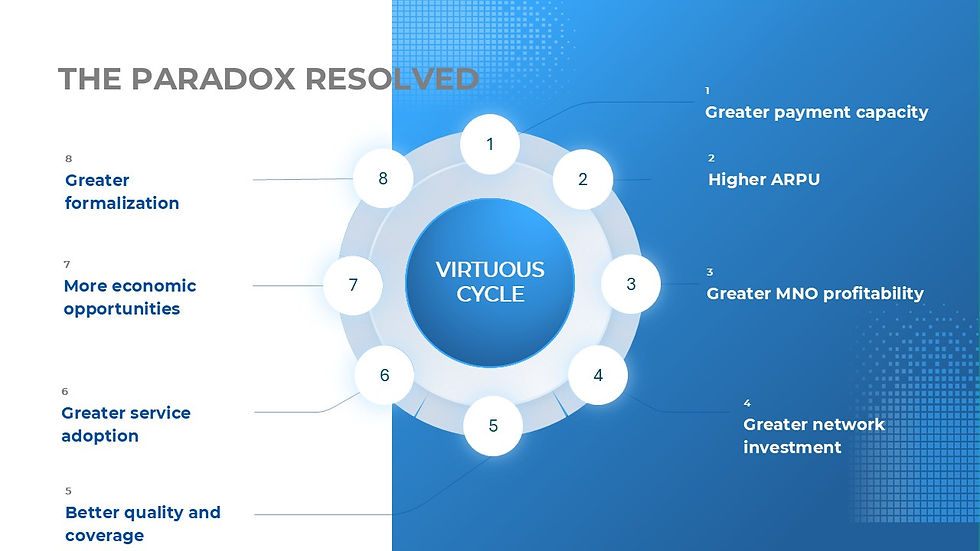
- Enhanced Consumer Experiences: Even in rural settings, 5G delivers superior quality of experience (QoE)—higher throughput, lower latency, and improved reliability—supporting premium service tiers, fixed wireless access (FWA), and bundled digital services that drive ARPU growth.
- Digital Inclusion Partnerships: Governments and development agencies increasingly prioritize high-quality connectivity for socioeconomic development. MNOs deploying 5G in rural areas position themselves as stategic partners for public-private initiatives, unlocking subsidies, universal service fund allocations, and co-investment opportunities.
Artifex Consulting’s Strategic Framework for Rural 5G Deployment
At Artifex Consulting LLC, we believe that the most effective pathway to deliver broadband connectivity to rural areas—whether via mobile networks or Fixed Wireless Access (FWA) to the home—is through native 5G deployment. This approach mirrors successful models in the United States, where 5G FWA has consistently proven more economically viable than Fiber-to-the-Home (FTTH) in specific geographic and demographic contexts. To achieve this at scale, we identify four strategic imperatives:
- Deploy 5G in rural markets leveraging our SpectrumInvest Shared™ and Invest- Drivers™ frameworks. This integrated approach enables MNOs to reduce both CAPEX and OPEX by 35–45%, optimizing capital allocation while maintaining stringent network performance and coverage standards.
- Utilize the full 90 MHz of 700 MHz low-band spectrum (45+45 MHz FDD) through a shared licensing model (SpectrumInvest Shared™). Maximizing paired spectrum allocation increases peak download speeds, preserves consumer choice of operator, fosters healthy market competition, and ensures equitable service access for rural populations.
- Leverage Invest-Drivers™ to systematically lower telecommunications equipment costs for MNOs while simultaneously driving down 5G smartphone retail prices. This dual cost-reduction mechanism accelerates device ecosystem adoption, expands the addressable market, and improves subscriber acquisition economics.
- Harness SpectrumInvest Shared™ to scale network capacity, increase concurrent user connectivity, and enable cost-efficient rural FWA deployments in the 3.5 GHz mid- band. By optimizing spectrum utilization and infrastructure sharing, MNOs can significantly lower lifecycle costs, enhance service margins, and unlock sustainable profitability in traditionally underserved markets.
Conclusion: A Forward-Looking Policy Framework
While short-term cost containment is a valid policy objective, a truly rational and innovative approach to rural connectivity must balance immediate affordability with long-term value creation. Prioritizing 5G—even in early-stage rural deployments—aligns technological capability, economic efficiency, and revenue potential. It empowers MNOs to build scalable, future-ready networks; enables governments to advance digital inclusion with sustainable infrastructure; and ensures that rural communities benefit not only from connectivity, but from the full spectrum of economic and social opportunities that next-generation networks enable.
In this light, spectrum policy should incentivize, rather than constrain, the adoption of the most advanced and economically rational technology available—recognizing that the greatest cost is not in deploying 5G today, but in delaying the inevitable transition tomorrow.


Comments