


5G: Nine Lessons from the Spectrum Auctions — Already Embedded in Our Models


By Gerardo Mantilla | CEO & Founder, Artifex Consulting LLC
The global cycle of spectrum assignment for 5G is, for all practical purposes, closed. It was the largest public-policy experiment in telecommunications of the past decade: dozens of auctions, billions of dollars raised, and deployments that, in many markets, failed to deliver the performance the technology had promised. Some of these lessons we flagged publicly — in The Strategic Economics of 5G Deployment, and The MNO Growth Paradox in Mexico — while others we reserved for our client engagements. Today we consolidate them into the lessons below. Artifex Consulting LLC was the first firm to integrate these elements into the design of a spectrum valuation model (SpectrumInvest), an auction procedure (SpectrumInvest Procedure), a sharing model (SpectrumInvest Shared), and a framework of investment accelerators (Invest-Drivers). These are not retrospective observations: they are the design assumptions of our models, validated by the successes and failures of valuation and auction processes worldwide.
Lesson 1 — 5G Is a Single Network with Two Layers: Valuing Bands in Isolation Is an Economic Error
From 5G onward, service is delivered over a multi-layer architecture: low bands (coverage, indoor penetration, fewer sites) and mid bands (capacity, speed, more users per base station). They are complements, not substitutes. The customer pays the same price regardless of the band that serves them; attributing revenue by band and valuing each in isolation — with different reserve prices and separate auctions — therefore has no economic foundation. The value of 80–100 MHz of contiguous 3.5 GHz spectrum to an operator that already holds low-band spectrum is not the standalone value of that band: it is the incremental value of the complete portfolio. Ignoring this complementarity systematically overvalues or undervalues spectrum and exposes bidders to the classic exposure problem in sequential auctions.
Lesson 2 — High Bands Lack Economic Value: Direct Assignment Is the Efficient Route
Most spectrum auctions that included high bands — above 25 GHz — either went unsold or attracted no competitive bidding, with licenses awarded at the pre-set reserve price. As we have recommended in several of our publications, these bands carry no economic value; the most efficient approach is therefore direct assignment. Given the abundance of available spectrum and the limited coverage these bands provide, two operators can reuse the same portion of spectrum in different locations only a short distance apart, without material interference risk.
Lesson 3 — Partial Deployments: Adoption Does Not Come on Its Own
Several markets launched 5G with some operators deploying only low-band spectrum and others only mid-band. The outcome was predictable: a low-band-only network with a 10 MHz or 20 MHz channel delivers an experience virtually indistinguishable from LTE-A, while a mid-band-only network leaves gaps in indoor coverage. In both cases the value proposition is diluted, users see no compelling reason to migrate, and adoption rates are depressed. Genuine 5G differentiation requires both layers operating as a single network; any assignment design that fragments them shifts the cost onto the operator's business case.
Lesson 4 — The Time Between Auctions Destroys NPV and ROI
When a regulator separates the assignment of low and mid bands by two, three, or four years, it condemns operators to launch a service that falls short of what the technology promises. Spain auctioned 3.5 GHz in 2018 and 700 MHz in 2021; the United Kingdom raised £1.37 billion in 2018 and £1.38 billion in 2021 in separate processes. The financial impact is unequivocal: the early years generate weak cash flows while CAPEX, OPEX, and spectrum fees are already accruing; when the remaining spectrum finally arrives, returns must be assessed from the initial year of deployment, not from the "second stage."
Lesson 5 — Non-Standalone: The Shortcut That Makes the Journey More Expensive
Launching 5G on top of the 4G core (NSA) accelerates time-to-market, but it constrains end-to-end slicing, URLLC, and the enterprise monetization that justifies the business case; it also forces a phased migration toward SA that duplicates integration and testing. The market confirms this: of more than 390 operators that launched commercial 5G, only ~98 had launched 5G Standalone as of October 2026 (GSA). Adoption and B2B revenues are delayed, and with them the return on investment. Spectrum valuation must model the quality actually deliverable, not the nominal quality of the technology. In addition, the effective throughput and service capabilities delivered by an NSA network fall short of those of a full SA deployment, raising a barrier to capturing early adopters.
Lesson 6 — 5G's "Coverage-First" Approach Is 6G's Hidden CAPEX
Prioritizing low bands and minimizing mid-band sites cheapens today's deployment but mortgages the future. 6G will operate in higher bands — WRC-27, under Agenda Item 1.7, is studying the ranges 4.4–4.8 GHz, 7.125–8.4 GHz, and 14.8–15.35 GHz for IMT — with tighter propagation constraints and greater site density. A network anchored in a dense 3.5 GHz grid can be partially reused; a sparse grid anchored in 700 MHz will force operators to build from scratch the densification that 5G failed to deliver. The 6G specifications will arrive with 3GPP Release 21 around 2028–2029: today's deployment decisions are tomorrow's CAPEX.
Lesson 7 — Economic Informality Bounds Real Demand, Not Coverage
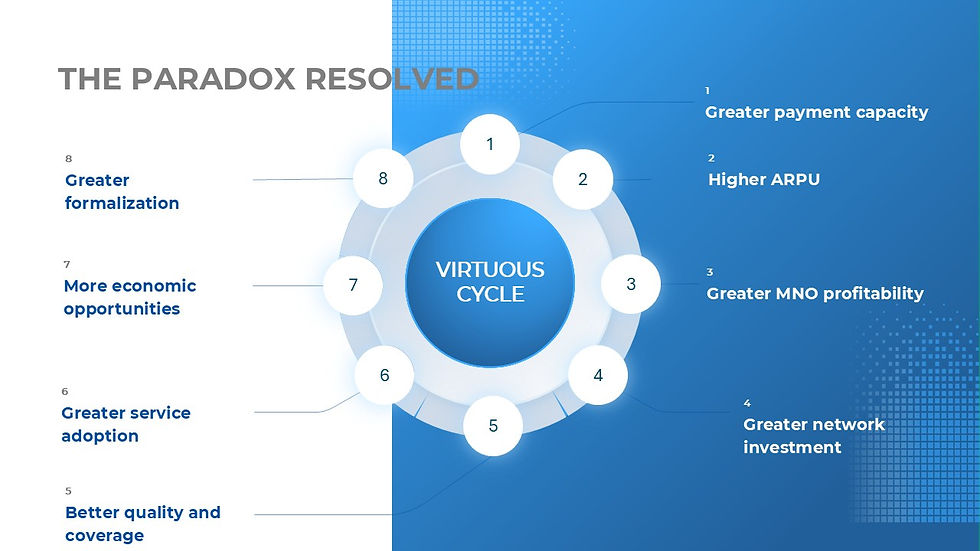
In developing economies, a large share of the population earns its income in the informal sector: more than 2 billion workers worldwide (ILO). Ability to pay is volatile and constrained, and line penetration far exceeds the adoption of quality data services. GSMA estimates that ~39% of the world's population lives within mobile broadband coverage but does not use it. Designing assignments and obligations to "cover 95% of the population" without modeling effective demand produces underutilized networks and compressed margins — the paradox we documented in The Connectivity Paradox. Valuation must start from ability to pay, and public policy must act on the demand side as well. We flagged this as early as 2020, in a publication released in Mexico and at an industry event in Chile — although the message was apparently not absorbed by the regulators and MNOs in attendance.
Lesson 8 — Selling the Towers Eased Cash Flow but Created Structural Dependence
Sale-and-leaseback transactions generated immediate liquidity: Verizon–American Tower for US$5.06 billion (2015), AT&T–Crown Castle for US$4.85 billion with exclusive rights over ~9,100 towers for ~28 years (2013), and Telefónica–American Tower (Telxius) for €7.7 billion (2021). The relief is real; so is the asymmetry. Every new band, every sector split, and every additional 5G/6G site becomes a lease amendment or a new lease with escalators, in a market where TowerCos concentrate the best urban sites. Long-term OPEX rises, margin transfers from the MNO to the infrastructure owner, and dependence becomes strategic.
Lesson 9 — Spectrum Prices Cannot Be Set in Disregard of the Market
Reserve prices, annual fees, and coverage obligations defined without an investment-based valuation model produce three well-documented pathologies: unsold spectrum — in India's 2022 auction, the entire 26 GHz band went unsold owing to disproportionate reserve prices; spectrum returns — Telefónica and AT&T handed back spectrum in Mexico in the face of unsustainable annual fees, and a 2023 tender attracted no bids; and the winner's curse — the U.S. C-band auction raised US$80.9 billion, to which some US$15 billion in clearing and accelerated relocation payments were added, draining the CAPEX available for deployment. Add to this coverage obligations in bands and technologies other than those auctioned, which we analyzed in Beyond 4G Obligations. Spectrum prices must be derived from the investment the market can sustain — not the other way around.
From Lesson to Model: How This Translates into the SpectrumInvest Family
Artifex Consulting LLC was the first firm to consider these nine elements in an integrated manner:
- SpectrumInvest — valuation based on five-year deployment investment (access, backhaul, transport, terminals, and coverage), across multi-band portfolios and accounting for the investment capacity of the smallest operator. Addresses Lessons 1, 2, 3, 5, and 9.
- SpectrumInvest Procedure — an SMRA procedure with two innovations: investment offers (five-year NPV) instead of price, and a spectrum price inversely proportional to the investment offered; simultaneous assignment of low, mid, and high bands. Addresses Lessons 1, 4, and 9.
- SpectrumInvest Shared — a technical-regulatory model for spectrum and network sharing that promotes rural coverage rather than mandating it, with a reasonable return and competition preserved. Addresses Lessons 7 and 8.
- Invest-Drivers — investment accelerators acting on both supply and demand to recover investment in rural and limited-coverage areas, transferring the benefit to the real economy. Addresses Lessons 6 and 7.
The evidence is clear: assignment design is investment policy. With 6G on the horizon and WRC-27 just around the corner, the question is no longer how much to raise, but how much to deploy. At Artifex Consulting, we have spent years answering that question with models, not intuition.
Note: This article and the underlying research were developed by Artifex Consulting LLC, holder of all intellectual property rights, data, charts, and analyses. It may not be quoted, reproduced, distributed, or published for commercial purposes without prior consent. Members of the press and third parties may share and link to this information for non-commercial purposes, with attribution to Artifex Consulting LLC and prior notification by email.

Comments